


Top N RF Fixed Attenuator Brands and Models Analysis

You face an important choice when picking an n rf fixed attenuator for your system. Top brands like Amphenol RF, Pasternack, Spectrum Control, ZOMWAVE, and Teruilai lead the market with their key N-type models. The most important factor to choose is making sure the attenuation accuracy, power rating, and frequency range fit your use. These three details decide if your rf signal stays strong or gets worse. This post compares these top brands on performance, price, and reliability. You will then choose attenuators with confidence for your next project.
Key Takeaways
Choose an attenuator for its attenuation accuracy, power rating, and frequency range.
Amphenol RF and Spectrum Control are great for lab accuracy and wideband performance.
Pasternack is the best at handling high power for base stations and transmitters.
ZOMWAVE gives low-cost choices for people who buy in bulk, with fast shipping.
Teruilai offers custom solutions and high-frequency models that go up to 50 GHz.
What Is an N RF Fixed Attenuator?
Definition and Working Principle
An N RF fixed attenuator lowers RF signal power by a set dB value. It does this while keeping the signal clear. You use one when a signal is too strong for the next stage in your system. The device lowers the power level without twisting the waveform.
Common attenuation values include 3 dB, 10 dB, 14 dB, and 20 dB. The attenuation formula is 10 log (input/output). A 10 dB attenuator gives you an input-to-output ratio of 10:1. Most fixed attenuators use 50 Ω impedance. This matches the normal impedance of RF and microwave systems. You can also find 75 Ω versions for video and broadcast work.
Connector options for coaxial attenuators include SMA, N-type, BNC, TNC, 2.92 mm, and 2.4 mm. Your choice depends on operating frequency, power level, and application needs. N-type connectors handle higher power and give strong performance in harsh places.
Typical Applications and the N Connector Advantage
You will find these attenuators in many RF systems. They serve test and measurement setups, telecommunications gear, and broadcast equipment. Engineers use them to protect sensitive receivers from strong signals. They also help match signal levels between different parts.
The N connector gives you a tough, weather-resistant interface. It supports frequencies up to 6 GHz in many standard models. Power ratings range from 2 W to 100 W. An example N-type attenuator covers up to 6 GHz with 10 W power handling and 20 dB attenuation. These traits make N-type models great for base stations, radar systems, and field deployments. You get reliable performance when conditions are rough.
How We Evaluated the Top Brands

Performance Criteria: Frequency, Accuracy, VSWR, Power
You need clear benchmarks to judge any N-type attenuator. I scored every model on four core specs: frequency range, attenuation accuracy, VSWR, and power handling. These four parameters decide how well a device performs in your system.
Frequency response matters because standard models cover about 5 GHz. High-performance versions reach up to 50 GHz. A wider bandwidth lets you use one attenuator across more projects. Attenuation accuracy shows the gap between measured and ideal attenuation. This value changes with frequency across the band. VSWR measures how well the attenuator matches impedance. A low VSWR improves return loss and reduces the mismatch your adjacent components see. Power handling sets the maximum input power the device absorbs without damage or distortion. You should pick a power rating at least 25% above your maximum input power.
The table below shows typical benchmarks across attenuator categories.
Category | Frequency Range | VSWR | Accuracy | Power Handling |
|---|---|---|---|---|
Low Power Coaxial | DC to 50 GHz | 1.1:1 | ±0.5 dB | 0.5 to 2 W |
Medium Power Coaxial | DC to 40 GHz | 1.1:1 | ±0.6 dB | 5 to 50 W |
High Power Coaxial | DC to 18 GHz | 1.1:1 | ±0.6 dB | up to 500 W |
Commercial Criteria: Price, Availability, and Support
Performance alone does not settle the choice. You also weigh price, stock availability, and vendor support. A premium coaxial attenuator costs more, but it may save you money through longer service life and fewer replacements.
I compared listed prices, lead times, and technical support quality across all five top brands. I also read user reviews to gauge real-world reliability. A brand with fast shipping and responsive engineers earns a higher score. Custom design services and sample availability also count. These commercial factors often decide which fixed attenuators you buy for volume deployment.
Amphenol RF: Precision N-Type Models
Key Models and Specifications
Amphenol RF is well known for making high-precision 50 ohm N-type coaxial attenuators. When signal quality is really important, engineers count on this brand. The company builds its N-type models to work steadily across the whole operating band. You get tight control over attenuation values, so your measurements stay the same each time.
These rf attenuators usually cover a frequency range that works for most lab and test setups. Standard versions handle medium power levels, while special models take higher input power. Attenuation accuracy stays tight across the band, which helps you trust every reading. The 50 ohm impedance matches common test equipment and cable assemblies. You can order values like 3 dB, 6 dB, 10 dB, and 20 dB to fit your chain.
Amphenol also sells a coaxial attenuator line with tough N-type interfaces. These parts stand up to wear from repeated connections. That matters in a busy lab where you swap components a lot. The design keeps VSWR low, so reflections stay small. You then protect sensitive instruments from strong signals without adding noise.
Pros, Cons, and Best Use Cases
Amphenol RF stands out in lab and test-and-measurement work. You get predictable behavior, solid build quality, and wide availability. The brand also gives good documentation, which helps you pick the right part fast. For bench setups, these attenuators give you the precision you need.
The downside is the cost. Amphenol parts often cost more than budget brands. You may also wait longer for custom values or unusual connector options. For high-volume field deployment, the price premium can add up. Still, the reliability often makes the extra cost worth it.
Pick Amphenol when accuracy and repeatability matter most for your project. These fixed attenuators work well for spectrum analyzers, signal generators, and receiver testing. You can also use them in production test racks where uptime matters. If your work needs tight tolerances, this brand earns its spot. For cost-sensitive jobs, you may check other options later in this list.
Pasternack: High-Power RF Attenuators
Key Models and Specifications
Pasternack makes N-type 50 ohm fixed attenuators for engineers who send a lot of power through a line. Its high-power family can handle up to 500 watts peak. This means you can lower signal levels in base station chains and high-power test benches without burning up the part. The table below shows four example models.
Model | Attenuation | Connector Type | Power Rating (CW) | Peak Power | Frequency Range |
|---|---|---|---|---|---|
PE7424-03 | 3 dB | N Male to N Female | 100 W | 500 W | Up to 18 GHz |
PE7424-06 | 6 dB | N Male to N Female | 100 W | 500 W | Up to 18 GHz |
PE7424-30 | 30 dB | N Male to N Female | 100 W | 500 W | Up to 18 GHz |
PE7426-10 | 10 dB | N Male to N Female | 25 W | 500 W | Up to 18 GHz |
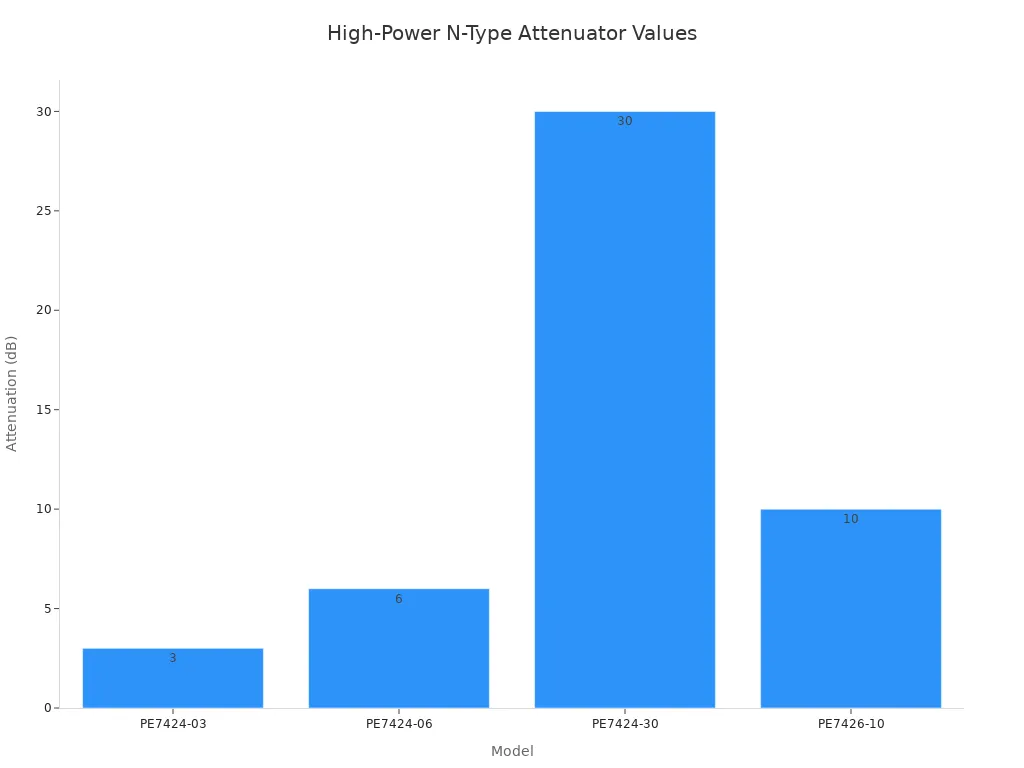
Every model covers the same frequency range up to 18 GHz. The PE7424 series carries 100 W continuous, while the PE7426-10 drops down to 25 W CW. All four share the 500 W peak number. Pasternack does not publish attenuation accuracy for these high-power units. Similar high-power coaxial attenuator designs from Bracke Manufacturing show accuracy from ±0.3 dB on lower-wattage parts to ±2.5 dB on the highest-power 500 W models. This depends on the attenuation value. Treat those numbers as a reference point, not a Pasternack spec.
Pros, Cons, and Best Use Cases
Pasternack sits between Amphenol RF and Spectrum Control on price. You pay less than you would for Amphenol's precision lab line. You also get far more power handling than Spectrum Control's low-power parts. That middle spot suits buyers who need tough hardware without a premium lab-grade bill.
The trade-off is accuracy documentation. Amphenol publishes tight tolerances for its precision models. Pasternack leaves that number off the datasheet for these high-power attenuators. You also give up some compactness, since 100 W parts run larger than low-power fixed attenuators.
Choose Pasternack when your rf chain carries real power. Base station commissioning, amplifier testing, and transmitter burn-in all work with these parts. You can also use them to protect spectrum analyzers during high-power measurements. For bench work where ±0.3 dB matters, look at Amphenol instead. For tight budgets, ZOMWAVE and Teruilai offer other paths.
Spectrum Control: Low-Power Coaxial Attenuator Options
Spectrum Control makes N-type fixed attenuators for low-power jobs. You use these parts when signal quality matters more than power handling. The product line is for test and measurement work. It also works in modern defense and aerospace systems. The company has a good name for small size. These parts give steady performance every time you use them.
Key Models and Specifications
The main spec for this coaxial attenuator is its frequency range. It works from DC up to 50 GHz. This wide range covers all modern systems. That includes 6G research, AESA radar testing, and advanced satellite links. Power handling is up to 5 Watts. That works well for receiver front ends and sensitive test gear. Attenuation flatness is very tight at ±0.2 dB. The signal stays steady across the whole band. VSWR is as low as 1.1:1. This low reflection keeps your measurements accurate. These parts work over a wide temperature range. They work from -65°C to +125°C without changing. You can order them with N-type, SMA, or 2.92mm connectors. The N-type is good for tough field use. The 2.92mm version works up to 50 GHz.
Pros, Cons, and Best Use Cases
Spectrum Control attenuators give you several benefits. Their wide bandwidth lets you use one part for many projects. The flatness and low VSWR give you consistent results. The build quality handles regular use well. A downside is the 5 W power limit. Do not use them in high-power transmitter chains. They also cost more than cheaper options from ZOMWAVE. But for precision RF work, the higher cost is worth it. You find these parts in receiver front ends. They work well in 5G and 6G lab tests. They also fit in AESA radar test stations. Pick Spectrum Control when accuracy and wide band coverage matter most.
ZOMWAVE: Budget-Friendly N-Type Models
Key Models and Specifications
ZOMWAVE offers a low-cost way to get N-type fixed attenuators. The company serves bulk buyers who want good parts without paying a high price. A 6 dB, 2 W N-type model costs $35.99. You get a passive part that meets RoHS and ISO rules. Small orders ship in 10 days. This speed helps you keep your projects on time.
The table below shows how ZOMWAVE compares across its product line.
Attribute | 6 dB, 2 W N-type | 100 W, 6 dB SMA | 60 dB, 25 W BNC | 60 dB, 150 W SMA |
|---|---|---|---|---|
Price | $35.99 | $849.56 | $67.85 | $250.74 |
Frequency range | Not specified | Not specified | DC–3 GHz | DC–4 GHz |
VSWR | Not specified | Not specified | 1.2 | 1.2 |
Compliance | RoHS, ISO | RoHS, ISO | RoHS, ISO | RoHS, ISO |
ZOMWAVE builds these rf attenuators to work the same way every time. The company says fewer than 0.5 percent have defects in bulk shipments. You get test reports with VSWR and attenuation curves. Bulk orders cut unit prices by up to 20 percent. You also get a dedicated engineering team. They help improve products and check performance. Flexible OEM and ODM manufacturing lets you tailor each coaxial attenuator to your system.
Pros, Cons, and Best Use Cases
ZOMWAVE gives bulk buyers of these attenuators several benefits.
Factory-direct pricing lowers what you pay to buy them
High-grade parts with strict quality control make them last longer
Helpful technical support with fast online replies
Flexible MOQs starting at 10 units for prototypes
98 percent on-time delivery rate tracked through ERP
Products are RoHS compliant and ISO certified, shipped in 10 days for small quantities
These attenuators work in many situations. You can use them for automated test equipment. They also work well for signal level equalization in multi-channel systems. They suit receiver protection before sensitive equipment. Field deployment favors N-type connectors because they are tough.
The main downside is documentation. ZOMWAVE does not publish attenuation accuracy for many models. You get fewer spec details for entry-level parts. For precision lab work on a tight budget, these fixed options still give strong value. You must check the specs carefully against your rf needs.
Teruilai: Custom N RF Fixed Attenuator Solutions
Danyang Teruilai Electronics Co., Ltd (TRL) began in 1998. The company is in Danyang city, Jiangsu Province, China. TRL designs and makes RF connectivity parts. You can get a custom N RF fixed attenuator that fits your system. The in‑house R&D team builds custom parts. Some trusted clients are Rohde & Schwarz, RFI, Mini Circuit, and ST. The attenuators from Teruilai meet strict quality rules. You gain from twenty‑five years in the RF market. Engineers trust these attenuators for important systems.
Key Models and Specifications
The N RF Fixed Attenuator works over a wide frequency range. Standard versions go up to 5 GHz. High‑performance models go up to 50 GHz. This range works for 5G systems, radar testing, and satellite links. The attenuation values go from 3 dB to 110 dB. You can choose fixed values such as 3 dB, 10 dB, 14 dB, and 20 dB. The formula used is 10 log (input/output). A 10 dB unit gives a 10:1 ratio. All attenuators use 50‑ohm impedance. This matches common test tools and cables. You can pick connector types such as N‑type, SMA, BNC, TNC, or SMC. Each coaxial attenuator gives tight signal control. The power rating changes by model. Custom designs can handle higher power. The frequency response stays even across the band. You get low VSWR, so reflections are small. These RF attenuators work well over many uses. The fixed design means you do not need to adjust it. You install the coaxial attenuator and then forget about it.
Pros, Cons, and Best Use Cases
Teruilai gives you strong advantages. You get custom solutions that match your exact needs. No other brand gives this flexibility. The engineering team works with you from design to delivery. You get test data with these attenuators. Clients around the world show the quality. The company ships worldwide using agents in India, Israel, and South Africa. You use these fixed attenuators in telecom, aerospace, defense, and 5G. Lab testing benefits from the precise attenuation. Field use gains from the rugged N connector. Engineers pick these attenuators for important tasks. High‑frequency uses up to 50 GHz work well. You also get quick engineering support. Custom cable assemblies give you more options. Choose Teruilai when you need a custom solution for complex systems. The company delivers parts that meet tough targets. Your system gets the exact attenuation without any trade‑off. High‑power attenuators handle hard conditions when needed.
Side-by-Side Comparison of Top Brands
Summary Table of Key Specs and Prices
You need one clear look at how these five top brands compare. The table below shows frequency range, power handling, attenuation accuracy, VSWR, and price. Use it to start your own checks.
Brand | Frequency Range | Power Handling | Attenuation Accuracy | VSWR | Price Position |
|---|---|---|---|---|---|
Amphenol RF | Common lab bands | Medium power | Very close limits | Low | Higher cost |
Pasternack | Up to 18 GHz | Up to 500 W peak | Not shown for high-power units | Low | Middle to higher |
Spectrum Control | DC to 50 GHz | Up to 5 W | ±0.2 dB | 1.1:1 | Higher |
ZOMWAVE | Depends on model | 2 W to 150 W | Not shown for many models | 1.2 on listed models | Low cost |
Teruilai | 5 GHz usual, up to 50 GHz | Depends on model, custom options | Tight control across band | Low | Price on request |
This table gives you a fast view of each brand. Amphenol RF and Spectrum Control lead on accuracy. Pasternack is best for high-power work. ZOMWAVE wins on price. Teruilai stands out for custom parts and high frequency.
Performance vs. Cost: Which Brand Wins Where
Your choice depends on which trade-off you can accept. Each brand wins in a different area.
Amphenol RF is best for lab accuracy. It gives very close limits and low VSWR. The higher price shows that quality. For bench work where every tenth of a dB matters, this brand is worth its cost.
Pasternack is best for high-power use. Its N-type models reach 500 W peak and 100 W steady. You pay less than Amphenol for similar build. The trade-off is missing accuracy data on high-power units. For base station and transmitter testing, that gap rarely hurts you.
Spectrum Control is best for wideband accuracy. Its coaxial attenuator covers DC to 50 GHz with ±0.2 dB flatness. The 5 W limit stops it from high-power chains. For receiver front ends and 6G research, this brand works well.
ZOMWAVE is best for low-cost projects. A 6 dB, 2 W N-type model starts at $35.99. You get RoHS and ISO compliance plus fast shipping. The trade-off is not much documentation. For volume buyers who can check specs themselves, ZOMWAVE saves real money.
Teruilai is best for custom and high-frequency needs. The n rf fixed attenuator line reaches 50 GHz in high-performance versions. Attenuation values go from 3 dB to 110 dB. You get in-house R&D that builds parts to your exact needs. Trusted clients like Rohde & Schwarz and Mini Circuit prove the quality. No other brand on this list gives the same design options. You also get worldwide support through agents in India, Israel, and South Africa.
These rf attenuators serve different jobs. Match the specs to your use. Then pick the brand that fits your budget and schedule. The right fixed attenuators protect your signal without wasting money on features you do not need.
Which N RF Fixed Attenuator Should You Choose?
Best for Lab and Test Bench Use
In a lab, you need very accurate parts. Amphenol RF and Teruilai both give the exactness your tests need. Amphenol RF has close limits and low VSWR on standard lab bands. Teruilai makes an n rf fixed attenuator that works from 5 GHz up to 50 GHz. You can get values from 3 dB to 110 dB. That covers almost every test you will do.
Teruilai's own team makes custom parts for hard systems. Big clients like Rohde & Schwarz and Mini Circuit show the quality is real. You get 25 years of RF knowledge with each order. These attenuators shield your tools from strong signals and do not add noise. They work well with spectrum analyzers, signal generators, and receiver testing.
The table below shows the N-Type interface platform specs you can expect from precision-grade parts.
Interface | Frequency Range | Power Capability | Product Class |
|---|---|---|---|
N-Type | Up to DC–18 GHz | Up to 500 W @ 18 GHz; 1000 W @ 6 GHz | General / high power |
Bracke Manufacturing also sells 50 Ohm fixed attenuators with N-type connectors. These parts work from DC to 65 GHz and handle up to 500 W. The maker says they have low VSWR and high accuracy for RF, telecom, and test uses. You can trust these numbers when you look at different choices.
Best for Field, Base Station, and High-Power Applications
Pasternack is best for high-power jobs. Its N-type models can take up to 500 W peak and 100 W steady. You can use these attenuators in base station links and transmitter tests without damage. The downside is that there is no accuracy data for the high-power units. But in the field, that missing info usually does not matter.
ZOMWAVE works well for low-budget projects. A 6 dB, 2 W N-type model costs only $35.99. It meets RoHS and ISO rules and ships fast. Buying in bulk lowers the price even more. For people who buy many units and can check the specs on their own, ZOMWAVE saves a lot of money.
Teruilai also works in the field. The strong N connector can handle tough conditions. Custom models can take more power if you need it. The company gives global support with agents in India, Israel, and South Africa.
The best pick depends on matching the specs to your use. Do not choose a brand only by its name. Check the frequency range, power rating, and accuracy against what you really need. A coaxial attenuator that works for one task may not work for another. You have to check every detail before you buy. That step saves your signal and your money.
You now have clear choices for each type of need. For precise lab work, pick Amphenol or Spectrum Control. If you need to handle high power, Pasternack is the one. For a budget-friendly setup, ZOMWAVE works well. If you need custom high-frequency solutions, go with Teruilai. The best attenuators come from matching specs to your job, not just the brand name. Always check the frequency range, power rating, and attenuation accuracy against what your system needs before you buy. Contact Teruilai at info@teruilai.com or visit https://www.rf-connector-china.com for a quote or spec sheet. These attenuators give you reliable parts for your projects. You get custom solutions from a trusted rf partner. Choose the right parts and protect your signals every time.
FAQ
What attenuation value should you pick for your system?
Find the needed value using your input and output power. The formula is 10 log (input/output). A 10 dB attenuator gives a 10:1 ratio. Common values are 3 dB, 10 dB, 14 dB, and 20 dB. Pick the one that fits your signal chain.
How do you choose between standard and high-frequency models?
Standard models work up to about 5 GHz. High-performance models go up to 50 GHz. Your system's frequency tells you which to use. 5G and radar systems often need the wider range. Check your system specs before buying.
Which brand works best for high-power applications?
Pasternack is best for high power. Its N-type models handle up to 500 W peak and 100 W steady. You can use these rf parts in base station links and transmitter tests. Teruilai also makes custom high-power options for tough systems.
Can you get custom attenuation values from manufacturers?
Yes. Teruilai makes custom attenuators from 3 dB to 110 dB. Their own team builds parts to your exact needs. You get test data with each order. Other brands have fewer custom choices than Teruilai.
What makes N-type connectors better for field use?
N-type connectors handle more power than SMA types. They stand up to weather and tough conditions. You get steady performance in base stations and field use. These attenuators work from DC to 18 GHz in most standard setups.


